Oral probiotics for teeth and gums: how Denta Guard’s good bacteria help
Oral probiotics flip the usual script on mouth care: instead of scrubbing every microbe away, they support a balanced community in which friendly bacteria keep the harmful ones in check. Here is what they are, which strains matter, how prebiotic inulin feeds them, and how to choose one — from the Denta Guard Research Team.
- Short version
- Oral probiotics deliver beneficial bacteria to the mouth to support a balanced microbiome. Strains like L. reuteri and L. salivarius are among the most studied, and prebiotic fibres such as inulin feed them. For oral benefit, let the product dissolve in your mouth rather than swallowing it whole.
- How Denta Guard uses this
- Denta Guard is a peppermint tablet with four probiotic strains (3.5 billion CFU) plus 100 mg of inulin from chicory root — probiotic and prebiotic together.
The mouth is an ecosystem, not a battlefield
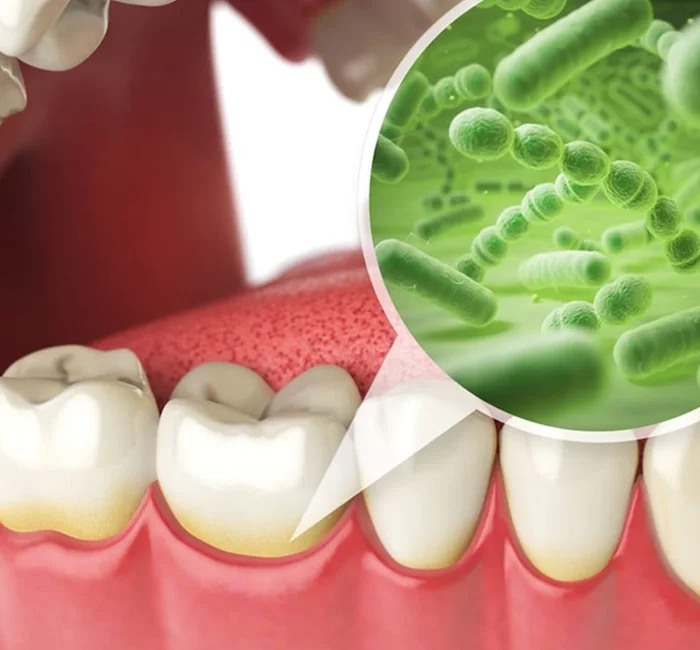
Your mouth hosts a vast community of bacteria — the oral microbiome — and most of its members are harmless or helpful. Problems arise not simply because bacteria are present, but because the balance tips toward the species associated with plaque, gum irritation and odour. Harsh, over-sanitising products can knock back the friendly bacteria along with the rest, leaving room for the wrong ones to rebound. Oral probiotics take the opposite approach: reseed and support the helpful side of the community.

What is an oral probiotic?
A probiotic is a live, beneficial microorganism that provides a benefit when taken in adequate amounts. An oral probiotic is simply one delivered so it can act in the mouth — a lozenge, chewable or dissolvable tablet you keep in the mouth rather than swallow. That distinction matters: a capsule that goes straight to the gut does little for your gum line. The goal of an oral probiotic is to help friendly species colonise the surfaces of the teeth, tongue and gums.
The strains most studied for the mouth
Not every probiotic strain is suited to oral care. A handful have drawn the most research attention for the mouth, and Denta Guard’s blend is built around four of them. The clearest picture of what that research shows comes from the pooled analysis by Benavides-Reyes C and colleagues, “Clinical effects of probiotics on the treatment of gingivitis and periodontitis: a systematic review and meta-analysis,” BMC Oral Health (2025), which found modest additional benefit when probiotics were added to standard dental care but flagged short follow-up and wide variation between trials. For breath specifically, the crossover trial by Suzuki N and colleagues, “Lactobacillus salivarius WB21-containing tablets for the treatment of oral malodor,” Oral Surgery, Oral Medicine, Oral Pathology and Oral Radiology (2014) is the kind of small, strain-specific study this field rests on. None of this makes any probiotic a treatment for a dental condition.
| Strain | Traditionally associated with |
|---|---|
| Lactobacillus reuteri | Gum comfort and a balanced oral community |
| Lactobacillus salivarius | The oral cavity; studied for breath and gum wellness |
| Lactobacillus paracasei | Adhering to oral surfaces and supporting balance |
| Bifidobacterium lactis BL-04R | A well-characterised strain for general microbiome support |
Denta Guard combines all four in a proprietary blend delivering 3.5 billion colony-forming units (CFU) per tablet. CFU is simply a measure of how many viable cells are present; a meaningful count matters, but so does keeping the cultures where they can act — in the mouth. See the full ingredient breakdown here.
Probiotic and prebiotic: why you want both
Live cultures do best when they have something to eat. That is where prebiotics come in. A prebiotic is a fibre the body does not digest but beneficial bacteria can ferment — in effect, their food, a mechanism set out in the review by Slavin J, “Fiber and prebiotics: mechanisms and health benefits,” Nutrients (2013). Pairing a probiotic with a prebiotic is sometimes called a “synbiotic” approach, and it is the logic behind Denta Guard’s formula.
| Probiotic | Prebiotic | |
|---|---|---|
| What it is | Live beneficial bacteria | Fibre that feeds them |
| In Denta Guard | 4-strain blend, 3.5B CFU | Inulin (chicory root), 100 mg |
| Role | Reseed the good community | Help it establish and flourish |

Cranberry, grape seed and a tooth-friendly base
Denta Guard rounds out its cultures and fibre with plant polyphenols from cranberry and grape seed, plus carrot for naturally occurring carotenoids. That pairing is not arbitrary: Koo H and colleagues, “Influence of cranberry proanthocyanidins on formation of biofilms by Streptococcus mutans on saliva-coated apatitic surface,” Caries Research (2010) showed cranberry proanthocyanidins interfering with how Streptococcus mutans builds biofilm on a tooth-like surface, and the systematic review by Castellanos JS and colleagues, “Effect of flavonoids from grape seed and cranberry extracts on the microbiological activity of Streptococcus mutans,” BMC Oral Health (2024) collected the comparable grape-seed findings. Both bodies of work are laboratory studies rather than human trials, so they explain why these botanicals are included, not what a tablet will do for you. The whole tablet is built on a xylitol base — a sugar alcohol widely used in dental products — and finished with peppermint and stevia, so it tastes fresh without feeding the very bacteria you are trying to keep in balance — the same reasoning behind the xylitol step in our guide to getting rid of bad breath naturally. Our gum-health guide covers how these habits fit a daily routine.
Probiotic and prebiotic, in one minty tablet
Denta Guard pairs four studied strains with prebiotic inulin, cranberry and grape seed. The six-bottle bundle is the best value with free U.S. shipping and a 60-day guarantee.
Order Denta GuardHow to choose — and use — an oral probiotic
When you compare oral probiotics, look for a product designed to stay in the mouth, a clear strain list, a stated CFU count, and ideally a prebiotic to support the cultures. Avoid products loaded with sugar, which works against the goal. Then use it correctly: for oral benefit, let the tablet dissolve after brushing rather than swallowing it whole, and be consistent — a balanced microbiome builds over weeks, not overnight. Here is the simple Denta Guard routine.
One more expectation to set: an oral probiotic is a supplement for wellness, not a medicine. It does not treat gum disease, cavities or any condition, and it works best as a complement to brushing, flossing and regular dental visits — never a replacement for them.
It also helps to think about timing and consistency rather than dose alone. Because the cultures work by gradually establishing themselves on the surfaces of the mouth, taking a tablet at the same point in your routine each day — most people choose right after their evening brush — gives them the best chance to settle in overnight, when you are not eating or drinking. Pair that habit with the everyday basics covered in our other guides, keep your regular dental check-ups, and let the routine run for a few months before you judge how it fits. Small, repeatable steps are what build a balanced mouth, and an oral probiotic is simply one more of them.
References
- Benavides-Reyes C, Cabello I, Magán-Fernández A, et al. Clinical effects of probiotics on the treatment of gingivitis and periodontitis: a systematic review and meta-analysis. BMC Oral Health, 2025. Benavides-Reyes C et al., “Clinical effects of probiotics on the treatment of gingivitis and periodontitis,” BMC Oral Health (2025)
- Suzuki N, Yoneda M, Tanabe K, et al. Lactobacillus salivarius WB21-containing tablets for the treatment of oral malodor: a double-blind, randomized, placebo-controlled crossover trial. Oral Surgery, Oral Medicine, Oral Pathology and Oral Radiology, 2014. Suzuki N et al., “Lactobacillus salivarius WB21-containing tablets for the treatment of oral malodor,” Oral Surg Oral Med Oral Pathol Oral Radiol (2014)
- Koo H, Duarte S, Murata RM, et al. Influence of cranberry proanthocyanidins on formation of biofilms by Streptococcus mutans on saliva-coated apatitic surface and on dental caries development in vivo. Caries Research, 2010. Koo H et al., “Influence of cranberry proanthocyanidins on formation of biofilms by Streptococcus mutans,” Caries Res (2010)
- Castellanos JS, Betancourt DE, Díaz-Báez D, et al. Effect of flavonoids from grape seed and cranberry extracts on the microbiological activity of Streptococcus mutans: a systematic review of in vitro studies. BMC Oral Health, 2024. Castellanos JS et al., “Effect of flavonoids from grape seed and cranberry extracts on the microbiological activity of Streptococcus mutans,” BMC Oral Health (2024)
- Slavin J. Fiber and prebiotics: mechanisms and health benefits. Nutrients, 2013. Slavin J, “Fiber and prebiotics: mechanisms and health benefits,” Nutrients (2013)
- Riley P, Moore D, Ahmed F, et al. Xylitol-containing products for preventing dental caries in children and adults. Cochrane Database of Systematic Reviews, 2015. Riley P et al., “Xylitol-containing products for preventing dental caries in children and adults,” Cochrane Database Syst Rev (2015)
- National Center for Complementary and Integrative Health. Probiotics: What You Need To Know. NCCIH, “Probiotics: What You Need To Know”
This article is for general information and is not a substitute for professional dental or medical advice.
Frequently asked questions
What are oral probiotics?
Oral probiotics are beneficial bacteria delivered in a form that lets them act in the mouth, such as a lozenge, chewable or dissolvable tablet. Rather than trying to kill all microbes, they aim to support a balanced oral microbiome in which friendly species help keep the harmful ones in check.
Which probiotic strains are studied for the mouth?
Strains including Lactobacillus reuteri, Lactobacillus salivarius, Lactobacillus paracasei and some Bifidobacterium species are among those most studied for oral wellness. Denta Guard combines these four strains in a proprietary blend delivering 3.5 billion CFU per tablet.
What is the difference between a probiotic and a prebiotic?
A probiotic supplies live beneficial bacteria; a prebiotic is a fibre that feeds them. Inulin, the prebiotic in Denta Guard, is a soluble fibre from chicory root that acts as food so the friendly cultures can establish and flourish.
How do you take an oral probiotic?
For oral benefits, the product should stay in the mouth rather than be swallowed whole. Denta Guard is a peppermint tablet you let dissolve after brushing, so the cultures and botanicals can spread across the teeth and gums. See the current packages.
Are oral probiotics safe?
Probiotic strains used in supplements are generally well tolerated in healthy adults. Denta Guard is made in a GMP-compliant facility and is not intended for children under 18 or for those who are pregnant or nursing. If you take medication or have a medical condition, ask your doctor first.
How long until oral probiotics help?
A balanced oral microbiome builds gradually, so most people use an oral probiotic daily for several weeks to a few months before judging it. Consistency matters more than any single dose, and individual results vary.